
Bruce Lee wanted to create a unique martial arts film which included both action and philosophy. Unfortunately he never made this movie. The following is a summary of his plans.
New Vision, October 24, 1969
“Lee sees a new vision in the movies. One of action, in which the combinations of all forms of defense and attack on the human body – Martial Art – will be the vanguard.”
“There has been an era in movies that immortalized the western hero, the swordsman and now, if I can do it with James Coburn (Our Man Flint) in a new movie we both star in, The Silent Flute, Martial Art will be next.” (From an October, 24 1969 article Don’t Order Gung Fu From Bruce Lee, Words, 91).
“My next one – ‘The Silent Flute’ – is going to be great. Has James Coburn in it. It will be full of the best self-defense artists in the world. We’ll film it in Japan.” (From an October 24, 1969 article, Chop Talk with an Actor: Mayhem Up his Sleeve, Lee says, Words, 93).
Film Production Company, January 11, 1970
“Recently, I have organized a film production company. I have also written a story ‘The Silent Flute.’ James Colburn and I will act in it. Stirling Silliphant is the screen play writer. He is famous screen play writer (In the Heat of the Night). We plan to make the first martial arts film in Hollywood. The prospect is good. About six months from now, the filming work will begin. All who participate in this film are my students. In the future, Steve McQueen may also work together with me. I am very excited about this plan.” (From a January 11, 1970 letter to Wong Shun-Leung, Letters, page 123).
Based in India, February 18, 1970
“By the way, I’m doing a film The Silent Flute for Warner Bro. this fall in India. The picture is based on martial art and will be released in ’72. You should enjoy it. I wrote the original story. The screenplay is a joint effort, headed by Stirling Silliphant (In the Heat of the Night), a most able screen writer here in Hollywood.” (From a February 18, 1970 letter to William Cheung he writes, Letters, page 127).
Polanski as director, April 4, 1970
“James Coburn and Bruce Lee himself, will star in the first film Bruce’s movie company is going to make, called Silent Flute. Shooting begins soon in India. ‘We are hoping to get Roman Polanski as director, I have talked to him about this in Switzerland.’” (From an April 4, 1970 article, Bruce Quitting Boxing for Acting, Words, page 94).
Different Levels of meaning, August 16, 1970
“Lee, Colburn and Silliphant have entered into a joint venture for a movie called Silent Flute. Obviously, it is a martial arts film. Lee has plans for a series of such movies.”
“It’s about time we had an oriental hero,” he said. ‘Never mind some guy bouncing around the country in a pigtail or something. I have to be a real human being. No cook. No laundryman.”
“In this movie there’s something to appeal to different people on different levels. There’s enough violence to satisfy almost anyone. Yet there’s a study of man’s evolution and attitude as Coburn meets people and finds death and love, looking for the ultimate truth.” (From an August 16, 1970 article, Don’t Call it Karate – It’s Martial Arts, Words, page 98).
1970-1971
During 1970-71 Lee worked with the actor James Coburn and screenwriter Stirling Silliphant on a screenplay about the philosophy of martial art (Letters, page 16).
Film Locations in India, January 29-February 11, 1971
“On January 29, 1971, Bruce Lee left Los Angeles for India to scout locations for The Silent Film, a film he intended to make. Accompanying him were Hollywood superstar James Coburn and Academy Award – winning screenwriter Stirling Silliphant, both students of his. They arrived in New Delhi, India on Monday, February 1, 1971, and scouted locations until Thursday, February 11, 1971. During this ten-day period, while driving across the Indian desert, Bruce found time to write the following letter.” (Letters, page 172, Note 1).
“Silent Flute is still on with Warner Bros. We are waiting to hear the next step, and should know within ten days – approval of new budget, setting up another survey trip, etc.” (From a February 1971 letter Bruce Lee writes from India to John Goo Rhee, Letters, page 144-145).
Screenwriter Stirling Silliphant
“The very best available martial artists will be used for the fight scenes; men from different styles, each showing his own best, characteristic techniques, and the hero, in defeating them would to some extent be an exemplar of JKD philosophy. That is a fixed style, a ‘frozen’ technical series of moves, could never ultimately defeat the alive, truly spontaneous individual. At the same time, the hero himself would undergo changes, because each time he defeated another adversary…And so the thoughts about the plot flowed on. Then it was decided that to ‘warm up’ the public, there would also be a type of documentary film released probably on television to show what martial arts were really all about. These were great thoughts, great plans, and they all made sense. (Anthology, page 35)
Movie Breaks Down
Eventually, the movie fell apart and was not made. Perhaps Lee had and Colburn had some personal disagreements or Lee went in another direction when he made hit movies in Hong Kong with Fist of Fury and The Big Boss. For a discussion of possible reasons you can check out this Screenrant post.
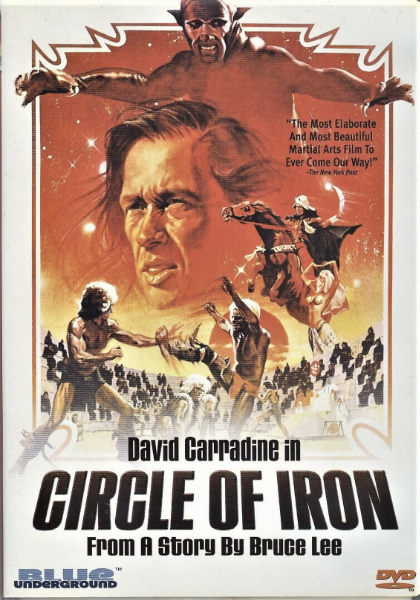
Circle of Iron
After Lee passed away, a version of the movie was released in 1978 staring David Carradine. It was called Circle of Iron aka Silent Flute. (Anthology, page 32).
“Fate intervened and it was left to his friends pupils and the movies business to fulfill his ambition for him. The result was an enjoyable martial arts movie with the theme of a quest, or search, probably Lee’s own search. Star David Carradine thought it could have been a lot better.” (Anthology, page 33).
The released Circle of Iron was not very popular and only received a 38% Tomatometer score (59% audience score) on the film review website Rotten Tomatoes (Rotten Tomatoes, Retrieved 4/1).
Conclusion
It is unfortunate that the Silent Flute was never made by Lee. I’m sure it would have been much better received. In The Silent Flute, Lee was set to play a martial arts expert who helped the main character in the movie. I found it interesting that David Carradine replaced Bruce Lee twice: once in The Silent Flute and once as the lead character of the tv series Kung Fu. Lee tried to use some of these themes from The Silent Flute in the original footage for the unfinished movie Game of Death. Both movies were meant to have different levels of meaning (martial arts and philosophy) as well as a quest to find a valuable treasure or knowledge.
Resources:
Letters of the Dragon: The Original 1958-1973 Correspondence, John Little, Editor, Tuttle Publishing, 1998, 2016. Volume 5 of the Bruce Lee Library, commissioned by the Bruce Lee Estate. Letters to friends, family, and business associates. Put together by John Little, Bruce Lee historian.
Words of the Dragon: Interviews, 1958-1973, John Little, Editor, Tuttle Publishing, 1997, 2017. Volume 1 of the Bruce Lee Library, commissioned by the Bruce Lee Estate. Interview transcripts of Bruce Lee on a variety of topics including philosophy, martial arts, and his personal life. Put together by John Little, Bruce Lee historian.
Bruce Lee Anthology: Films and Fighting, Paul Crompton, Author, Paul H Crompton Ltd. publisher, 1999. Articles from the Karate and Oriental Arts (KOA) magazine located in the United Kingdom.
Circle of Iron Rotten Tomatoes
AI Narration provided by elevenlabs.io. Bruce Lee quotes read by AI voice over.