
Early Life
Richard Bustillo was born in Hawaii in 1942. He studied Filipino martial arts at age 8, boxing at 10, and Kajukenbo at 14. He moved to California for college and competed in boxing tournaments.

Jeet Kune Do
Bustillo first saw Bruce Lee in 1964 at Ed Parker’s First International World Karate Championship.
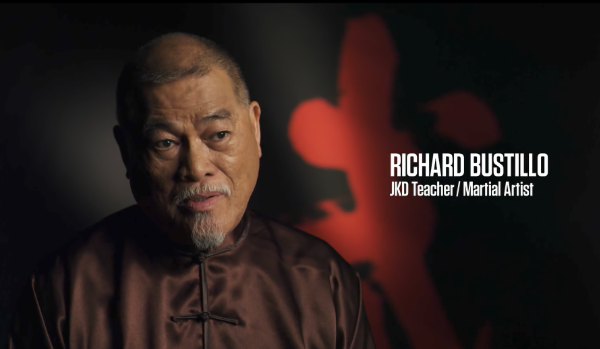
“When Bruce Lee came up and did his performance on his Gung Fu, it was something different I had never seen before. And he said the individual is more important than any style or system. That’s when I said I need to train like a man like this.” (I Am Bruce Lee).
At 24 he began to study under Bruce Lee at the Jun Fan Gung Fu Institute in Los Angelos.
“He said that to learn to swim you can not swim on land you have to get it on water. To learn to fight you got to fight.” (I Am Bruce Lee).
Bustillo had a lot of training sessions with Lee.
“One time we were training and Bruce was hitting the heavy bag – and he was going wild, like he was pissed off with the heavy bag. He was snorting and really whacking the bag…I asked him, “What was that about?’ He said, ‘That’s Jeet Kune Do – you’ve got to be emotionally involved when you train.” (The Art, page 155).
Bustillo would also train with Lee outside the Jun Fan Gung Fu institute.
“Back when I was training with Bruce, there wasn’t much talk of what they now call interval training. Bruce was already doing that before it became popular. And what he used to do, he’d be jogging for a while, and then he’d be sprinting, and then he’d jog, then he’d run backward, and then he’d jog; he’d even do crossovers…He ran backward for footwork and coordination because he realized that fighting is not just like jogging; sometimes you’ve go to turn fast or backpedal. That’s how he applied it, and that’s how he ran. That’s no fun running! Geez, to me, I like to do things and enjoy things. Man, that was a workout.” (The Art, page 148).
Bustillo was more than just a student and became a friend who visited Lee’s home.
“He had a huge library of books in his den from the ceiling to the floor. Any book I picked up there were notations about what was good, what was functional, what was no good.” (I Am Bruce Lee).
Bustillo continued to see Lee even after Lee moved to Hong Kong.
“The last time I saw Bruce was two months before he died, and I asked him, ‘Are you working out every day still?’ And Bruce jumped to his feet and said, ‘Oh yeah, Check this!’ He flexed his quadriceps and a muscle that inserted right into the hip joint just popped out. ‘Hit that!’ he said. So I did – Jesus! It was just like hitting a piece of wood! Man, it was hard! I said, ‘What’s that muscle for?’ And he said, ‘This is for the inverted kick – that’s the muscle that pops it out there.’ He told me that he had been doing special weight training to develop that.” (The Art, page 73-74).
Bustillo continued to study Jeet Kune Do even after Lee passed in 1973. In 1976 he became Senior Instructor in Jun Fan Jeet Kune Do under Dan Inosanto who was his friend and training partner. He continued to teach others Jeet Kune Do ‘Concepts.’
He was a founding member of the Bruce Lee Foundation which promotes Bruce Lee’s legacy and philosophy. He continued to be close to Lee’s family and even was a Jeet Kune Do Instructor to Lee’s children Brandon and Shannon.

Filipino Martial Arts
Bustillo helped spread Filipino martial arts around the world. In 1967 he studied the Filipino martial arts of Kali, Escrima, and Arnis under Angel Cabales. In 1976, Bustillo and Inosanto started the Filipino Kali Academy in Torrance, California.
In 1978, he studied Muay Thai and became a Kru in 1985. He also became a boxing coach for U.S. Amateur in Southern California. He was a Guro in Filipino martial arts and eleventh degree blackbelt.
Expanding Horizons
In 1984, he started the International Martial Arts & Boxing Academy (IMB) which later moved to Torrance, California. He taught mixed martial arts including Jeet Kune Do, boxing, May Thai, and Filipino martial Arts. He was not a fan of martial artists opening up a school and claiming to teach Jeet Kune Do.
“All the wannabes, all the imposters who put up Jeet Kune Do signs in their school building and they have no idea what Jeet Kune Do is. They think it is a style. I don’t know if you did dojo busting in his days, but that would upset Bruce.” (I Am Bruce Lee).
In 1989 he was Instructor of the Year for the Black Belt Hall of Fame. In 1992 he starred with Ted Wong in the Bruce Lee’s Fighting Method documentary. He was also interviewed for the 2012 I Am Bruce Lee documentary.

Brustillo became a certified law enforcement defensive tactics instructor and a member of the L.A. Search and Rescue Team. He released instructional videos in JKD, boxing, and other martial arts.
He reflected on his life and the challenges he faced.
“Certain times they were prejudiced against my skin but I never let it bother me. Because in the back of mind I used to think I’ll take you out to the parking lot. I’ll beat your head in.” (I Am Bruce Lee).
He passed away on March 30, 2017 leaving behind a wife and four children but also a legacy of martial arts. His students continue to operate the IMB Academy to this day.
Resources:
Wikipedia, Retrieved 4/18/24.
IMB Academy, Retrieved 4/18/24.
I Am Bruce Lee. Excellent Bruce Lee documentary including his family, friends, and training partners. Includes much footage of Bruce Lee talking in interviews. 1h 34m (IMDB).
The Art of Expressing the Human Body, John Little, Editor, Tuttle Publishing, 1998. Volume 4 of the Bruce Lee Library, commissioned by the Bruce Lee Estate. Includes workouts, circuit training, weight lifting, and stretching. Put together by John Little, Bruce Lee historian.
Richard Bustillo image, Mike Searson, CC BY-SA 3.0 https://creativecommons.org/licenses/by-sa/3.0, via Wikimedia Commons.

Richard Bustillo class image, CC BY-SA 3.0 &lhttp://creativecommons.org/licenses/by-sa/3.0, via Wikimedia.

AI Narration provided by elevenlabs.io.
