
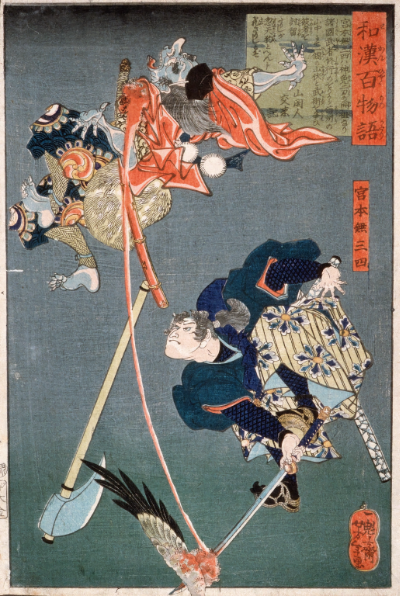
The Book of Five Rings is an ancient book on martial arts written in 1643 by the Japanese warrior Miyamoto Musashi. He was a masterless samurai and had his own martial arts school. He was known for being undefeated in duels. He divided his book up into the Earth, Water, Fire, Wind, and Emptiness Scrolls (Five, page xiii).
There are many similarities between The Five Rings and Bruce Lee’s philosophy. No doubt they are both influenced by Taoism and its focus on simplicity, flexibility, and nature. Musashi describes the martial way of life as excelling in anything and everything (Five, page 5). Lee uses the term “Gung Fu” in the same way.

Earth Scroll
The Earth Scroll outlines the science of martial arts. A martial artist should see both the big and small picture at the same time. A martial artists should use the great sword in larger areas and the small sword in confined areas. A martial artists should never be defeated without using both swords (Five, page 9-12).
In a similar way, Lee taught that a fighter should see the entire fight and anticipate what the opponent will do next. The use of two different length swords reminds me of Lee’s teaching on ranges. The leg is analogous to the long sword and the short sword is like the arm. Lee taught that a martial artist should use all tools at their disposal including groin and eye strikes.
The Earth Scroll says that people experience the rhythm of life with ups and downs or harmony and disharmony. In order to win a fight you have to know your opponent’s rhythm and use unexpected rhythms against your opponent (Five, page 15).
Lee often used the term “Broken Rhythm” to describe attacking an opponent in an unexpected way. Lee taught that you should identify the pattern of a fight and then change your attack to surprise your opponent.

Water Scroll
The Water Scroll teaches that a martial artist should have a flexible state of mind. Musashi writes, “Water conforms to the shape of the vessel, square or round; it can be a drop, and it can be an ocean.” (Five, page 9). A person’s mind should be open, direct, not tense, but not lax. The mind should be centered so there is no imbalance. The mind should never be hurried even if the body is. A small person should have the mindset of a large person and visa versa. The mind should remain the same as in combat as it is in regular life (Five, page 17-18).
Lee may have been inspired by The Book of the Five Rings when he said, “Empty your mind, be formless. Shapeless, like water. If you put water into a cup, it becomes the cup. You put water into a bottle and it becomes the bottle. You put it in a teapot it becomes the teapot. Now, water can flow or it can crash. Be water, my friend.”
Musashi goes on to write that a person’s gaze should be steady and the face should always have a serene expression. Power should be in the lower legs from the knees to the feet while the center should be tense and not bend. Your eyes should not move but should see what is far away closely and what is nearby like seeing from a distance. (Five, pages 18-19).
Lee taught that a martial artist should never telegraph a move or strike. There should not be any facial expressions while you are attacking an opponent.
Your footwork should be steady and both feet should move together (Five, page 20). Your guard position should adapt based on the situation. You should have a “sticky body” so there is no gap (Five, page 27).
Lee stressed the importance of footwork and that the back leg should propel the body to the target. Lee used the technique of Chi Sao or “sticky hands” with the idea that once the arms make contact with an opponent they should stay in contact. Lee demonstrated Chi Sao blindfolded which shows the importance of contact.

Fire Scroll
The Fire Scroll describes combat in Musashi’s school of martial arts (Five, page 10). A martial artist should notice their surroundings during a fight and pick a location that provides the best advantage. The sun should be to the back, the ground should be elevated, and there should be nearby obstacles to chase opponents into. Prior to attacking you should appear calm. During combat you should be “Holding down the pillow” which means to not let the opponent raise their head. You should perceive your opponent’s action and stop their opening. Musashi wrote that there are three preemptions or types of attack including an initial attack, attacking to intercept an opponent’s attack, and attacking at the same time as your opponent (Five, page 34-37). A martial artist should shout to “stir the opponent.” A martial artist should not do the same thing a third time (Five, Page 44-46).
The three preemptions reminds me of Bruce Lee’s Five Ways of Attack with the Single Direct Attack, Attack by Combination, Hand Immobilization Attack, Progressive Indirect Attack, and Attack by Drawing. Although Lee’s analysis is a little more complex.
Wind Scroll
The Wind Scroll is about the “style” of other martial arts schools (Five, page 10). He writes that there are not many ways to strike down others. The physical and mental should be simple and direct (Five, page 53). The eyes should not be focused on the opponents hands, weapons, face, or feet. Instead the eyes should be fixed “on the hearts and minds of the people involved.” He rejects leaping, sprinting, or stomping steps because they can make you unsteady. Instead there should not be any change in footwork different than walking. People should not be too fast or you will stumble and not too slowly either. You should not leave any gaps and not be rushed (Five, pages 55-57).
Lee also believed that fighting should be simple and direct and there were not that many effective martial techniques. “I personally do not believe in the word style. Why? Because, unless there are human beings with three arms and four legs, unless we have another group of human beings that are structurally different from us, there can be no different style of fighting.” Lee’s footwork was a compromise between being steady and being able to move quickly.
Scroll of Emptiness
The martial artist should strive for emptiness, “there is no obscurity and the clouds of confusion have cleared away.” This includes “practicing martial arts in the broadest sense, thinking correctly, clearly, and comprehensively, taking emptiness as the Way, you see the Way as emptiness. In emptiness there is good but no evil. Wisdom exists, logic exists, the Way exists, mind is empty.” (Five, page 59-60).
Lee taught that the Artlessness Stage was the highest level of a martial artist. A person should enter a “flow” and react to an opponent without thought in a fluid way.
Resources:
The Book of Five Rings, Musashi, Miyamoto, author, Cleary, Thomas, Translator, Shambhala Publications, Inc. 1993.
Mukojima Miyamoto Musashi Utagawa Kuniyoshi by Library of Congress is licensed under CC-CC0 1.0.
Arashi Rikan als Miyamoto Musashi by Rijksmuseum is licensed under CC-CC0 1.0.
Miyamoto Musashi Slashing Tengu Tsukioka by Los Angeles County Museum of Art is licensed under CC-CC0 1.0.
AI Narration provided by elevenlabs.io. Bruce Lee quotes read by AI voice over.