
Background
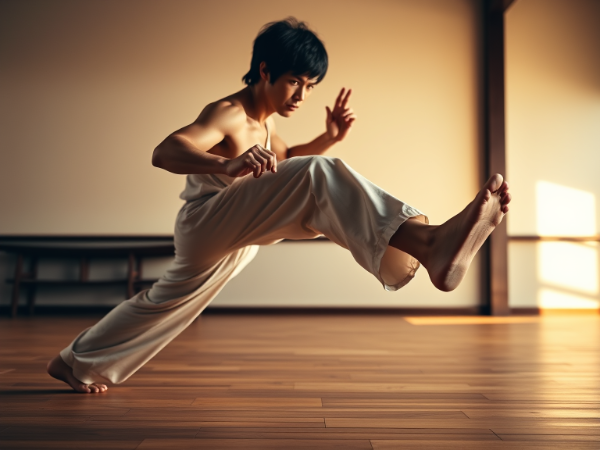
Jeet Kune Do (JKD) is Bruce Lee’s personal expression of Martial Arts. It is a Chinese Martial Arts mixed with boxing and fencing. It rejects formality and emphasizes fluidly reacting to the opponent in the moment. According to Lee a person should individualize their JKD and, “Absorb what is useful, discard what is not, add what is uniquely your own.”
“What is Jeet Kune Do? Chinese martial art, definitely! It is a kind of Chinese martial art that does away with distinction of branches, an art that rejects formality, and an art that is liberated from tradition…It is ridiculous to pin down so-and-so’s type of Gang Fu as ‘Bruce Lee’s Jeet Kune Do.’ I call it Jeet Kune Do just because I want to emphasize the notion of deciding at the right moment in order to stop the enemy at the gate. Really there is no rigid form in Jeet Kune Do. All that there is is this understanding: If the enemy is cool, stay cooler than him. If the enemy moves, move faster than him; be concerned with the ends, not the means; master your own manipulation of force, don’t be restricted by your form.” (Bruce Lee, 1972, Words, 126-128).
Curriculum
Here I have set down my interpretation of Lee’s JKD curriculum. This is only my interpretation and has been heavily influenced by the books Jeet Kune Do: A Comprehensive Guide to Bruce Lee’s Martial Way, John Little, Editor and Jeet Kune Do: The Arsenal of Self Expression, Teri Tom and the video Bruce Lee’s Fighting Method: Basic Training & Self-Defense Techniques. I have provided informative videos from the Dan Lok Youtube Channel featuring JKD instructor Octavio Quintero. This online curriculum allows you to become familiar with JKD but it is no subsitute for a qualified in person instructor.
JKD Stance
The JKD stance is heavily influenced by fencing. Normally the strong side foot is forward and the weak side foot is behind which is pointed at an angle with the heel slightly raised. The raised heel is like a trigger ready to propel the body forward. The knees are slightly bent and the hands are raised to protect the head. The strongside hand is in front of the weakside hand. The feet are a little wider than shoulder length.
JKD Footwork
The footwork should be economical and you should not move just to move. Don’t bounce needlessly but be controlled. Every movement is used to attack the opponent or to move away from an attack. Simplification and economy of motion are very important. One should be relaxed and ready to respond in an instant. Your footwork is used to advance, retreat, sidestep left, and sidestep right.
- Forward and Backward Shuffle (Step and Slide)
This involves taking a step forward and then gliding the back leg forward the same distance until you are back into the original JKD stance. The legs never cross one another. You can practice this in two movements and the shuffle is often used to size up your opponent at the beginning of a conflict. The Backward shuffle involves the back leg stepping back and the front gliding back until you are back in the JKD stance. Again the legs never cross each other.
- Sidestepping
This involves stepping to the left or right. To move right, the right foot goes first followed by the left. To move left, the left foot goes first followed by the right. The legs never cross one another. The body can slightly sway in the direction of the movement.
- Circling (Pivoting)
Circling is a variation of the side step. To circle right move the right foot first and to circle left use the left foot first. The second foot should pivot until you have settled back into the JKD stance.
- Quick Advance and Retreat (The Push Step)
The push step looks like the shuffle step but is faster. The back foot is propelling your body forward. It is not a hop and can be used to launch a punch or bridge the gap to an opponent. This is done in one fluid motion. The quick retreat is the opposite with the front foot pushing you to the rear.
Pendulum (Burst)
The pendulum step is used to quickly deliver a kick to an opponent. It involves one foot replacing the other foot in one fluid motion. The back leg swings forward and front leg moves out of the way to kick an opponent. This is less of a push and more of a pulling movement using your momentum. One can shuffle forward to attack or back to avoid an attack.
Health Information
This is for general informational purposes only. You should always consult a medical professional before engaging in any exercise program. Bruce Lee would have encouraged you to explore these training methods to see what works for you. Do not be afraid to modify this plan and adjust based on your own personal experience. “Adapt what is useful, reject what is useless, and add what is specifically your own.” Bruce Lee
Resources:
Dan Lok featuring Octavio Quintero Youtube Channel.
Words of the Dragon: Interviews, 1958-1973, John Little, Editor, Tuttle Publishing, 1997, 2017. Volume 1 of the Bruce Lee Library, commissioned by the Bruce Lee Estate. Interview transcripts of Bruce Lee on a variety of topics including philosophy, martial arts, and his personal life. Put together by John Little, Bruce Lee historian.
Jeet Kune Do: A Comprehensive Guide to Bruce Lee’s Martial Way, John Little, Editor, Tuttle Publishing, 1997, 2020. Volume 3 of the Bruce Lee Library. Excellent and detailed description of Bruce Lee’s martial art before he passed. Put together by John Little, Bruce Lee historian.
Bruce Lee’s Fighting Method: Basic Training & Self-Defense Techniques, Ted Wong and Richard Bustillo. 1992. Instructional video by two students of Bruce Lee which covers the JKD stance, footwork, power punching, and self defense. 52 M (IMDB).
AI Narration provided by elevenlabs.io. Bruce Lee quotes read by AI voice over.