

Listen to the podcast. Bruce Lee quotes read by AI. 

By 1968 Bruce Lee was working out 2 1/2 hours a day 6 days a week. He worked on his hands, legs, and stomach and would spar and run up to 6 miles a day. Let’s take a look at Lee’s workout.
The book, The Art of Expressing the Human Body by John Little outlined many of the workouts that Lee used throughout his life. Lee wanted to engage in activities to support his martial arts and designed his workouts to promote endurance, weight training, and flexibility.
Health Warning
Before we get started, keep in mind that this is for general informational purposes only. You should always consult a medical professional before engaging in any exercise program. Lee would have encouraged you to explore these training methods to see what works for you as an individual. He would tell you to modify this plan based on your own personal experience. Lee would say, “Adapt what is useful, reject what is useless, and add what is specifically your own.”
“Your wall punching bags have definitely helped in my daily training. I’ve started the training on Christmas eve – my 1968 resolution. I now train an average of two-and-a-half hours a day, including hand exercises, leg exercises, running, isometrics, stomach exercises, sparring exercises, free-hand exercises. Your training equipment all helps in my program. I did it this way. I trained my hands every Monday, Wednesday and Friday – and my legs on the alternate days.”
Bruce Lee, January, 1968 (Letters, page 105; Words, page 123)
Part 1: Weekly Workout
This is his weekly schedule which includes endurance, weight training, and flexibility. He varied his workouts at different times throughout his life. He would also replace this weekly plan from time to time with circuit training.
General Observations
Lee took Sunday off to rest and let his body recover. Each day he engaged in stomach, flexibility, and endurance exercises.
Stomach and Waist (Every day but Sunday)
He spent every day working on his stomach. He believed his core was very important for his martial arts. Here are the stomach exercises he used along with descriptions:
1. Sit ups: 15 to 20 per rep; roll your torso; hold for 1-2 seconds; twisting elbow
2. Side bends: stand, hold a dumbbell in one hand, bend to the side of dumbbell
3. Leg raises: lie on back, raise legs 18 inches
4. Flag: lay on back, hold supports and lift body to 45 degree angle, only shoulder touching
5. Twist: stand, hold a stick on back of shoulders, turn to side
6. Back bend: Stand, one leg in front, knees straight, bend back

Flexibility (Every day but Sunday)
He also spent every day on flexibility. It makes sense that he valued flexibility so much to help with his kicking and punching. He was not naturally flexible so he stretched six days a week. Here are the stretches he used along with descriptions:
1. Front stretch: stand, legs straight, bend and touch head
2. Side stretch: stand, raise one arm, knees straight, bend to other side
3. Hurdle stretch: sit, extend one leg, bend other leg at 90 degree angle, lay flat
4. Sit stretch: sit, bend legs, feet together, push knees to floor
5. Sliding stretch: bend knees, move one leg to front and then back
6. Front pulley stretch: need a pulley
7. Side pulley stretch: need a pulley
Weight Training (Tuesday, Thursday, and Saturday)
He trained with weights only three times a week to give his body time to recover. He chose specific exercises to support his martial arts and focused on the legs, chest, and arms. He used two different routines. Here are the exercises he did:
| Routine 1 | Routine 2 |
| Clean and press 2×8 Squat 2×12 Pullover 2×8 Bench Press 2×6 Good Morning 2×8 Curl 2×8 | Clean and press 4×6 Squat 4×6 Good Morning 4×6 Bench press 4×5 Curl 4×6 |
Punching (Monday, Wednesday, Friday)
He engaged in multiple types of punching and used both the heavy and speed bags along with sparring. He practiced punching three days a week. His routine included the jab, cross, hook, overhand cross, and punching combinations. He would use the platform speed bag and the top and bottom bag.
Kicking (Tuesday, Thursday, Saturday)
He also practiced kicking techniques three days a week. This included using the kick shield, heavy bag, and sparring. His routine included the side kick, hook kick, spin kick, rear front thrust kick (also known as the push kick), and heel kick (also known as the push heel kick).

Endurance (Everyday but Sunday)
He also spent each day on endurance. He wanted to make sure he had enough energy in a real fight. He varied his endurance activities to include running, cycling, and jump rope.
Running: (Monday, Wednesday, Friday)
Cycling and jump rope: (Tuesday, Thursday, Saturday)
Here is what a weekly workout schedule would look like with all the activities put together:
Part 2: Circuit Training
Not surprisingly, Lee was a pioneer in circuit training. He designed workouts that included going from station to station for a short period of time. He didn’t do circuit training every day but would rotate it with his regular weekly workout.
Here are two examples of his circuit training. He would do each activity for one minute and then quickly switch to the next one. He would alternate between Circuit A and Circuit B (Art, page 56-63).
Monday, Wednesday, Friday
| A | B |
| Rope jumping | Waist twisting |
| Forward bend | Palm up curl |
| Cat stretch | Roman Chair sit up |
| Jumping Jacks | knee drawing |
| Squats (no weights) | Side bending |
| High kick | Palm down curl |

Tuesday, Thursday, Saturday
| A | B |
| Groin stretch | Leg raise |
| Side leg stretch | Reverse curl |
| Jumping squat | Sit-up twist |
| Shoulder circling | Leverage bar twist |
| Alternate splits | Alternate leg raise |
| Leg stretch | Wrist roller |
What do you think? Is this something that would be helpful for you?
Part 3: Isometrics
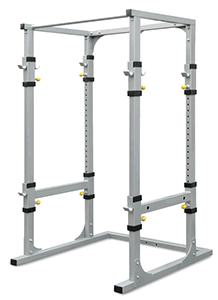
Lee used isometric exercise in the latter half of the 1960s. Isometric exercise improves a person’s ability to maintain strength over a long period of time and improves control and balance. Lee used isometric exercises to help get his ripped physique and it worked well with his strength training program to increase flexibility and muscle (Transparent Labs). Isometrics involves putting as much pressure as possible on an immovable object. Lee would use a power rack with the bar locked into a specific position but you can also use a heavy weight on a regular bar (Art, page 36).

Bruce Lee used a locked bar in a power rack to do Isometric exercise.
All of Lee’s isometric exercises were set three inches above starting position, three inches below finishing position, or at an intermediate position (Art, page 36).

Eight Isometric Exercises
Lee did the following eight isometric exercises:

1.
Press Lockout: Lay back on a bench and press up on the bar as hard as possible for 6-12 seconds. The bar should be set 3 inches below lockout position.
2.
Press Start: Lay back on a bench and press up on the bar as hard as possible for 6-12 seconds. The bar should be set at chin height.


3.
Rise on Toes: Rise up on your toes and push up as hard as possible for 6-12 seconds. The bar should be resting above your neck on your shoulder.
4.
Pull: Stand up holding the bar in front. Pull up as hard as possible doing a standing row for 6-12 seconds. The bar should be 6 or 7 inches below your waist.


5.
Parallel Squat: Horizontally squat pushing up on the bar as hard as possible for 6-12 seconds. The bar should be at shoulder height.
6.
Shoulder Shrug: Shrug up as hard as possible for 6-12 seconds. The bar should in front at a height fully extended down.


7.
Dead Weight Lift: Stand in front of bar and pull up as hard as possible for 6-12 seconds. The bar should be held two inches below knees.
8.
Quarter Squat: Stand in front of bar and push up as hard as possible for 6 to 12 seconds. The bar should be set 4 inches below your head.
Frog Kick: While this is not an isometric exercise, Lee would finish his isometric workout with this. Stand in front of bar, bar set to the highest position, hang by the bar and pull up knees to chest for 10-20 reps (Art, page 37-38).
Isometrics without a Power Rack
You can do Isometric exercises even if you don’t have a power rack. Lee would stand on a block tied to a rope or chain. If you are handy you can make your own Isometric tool. The key is that the object should not move.
Isometrics without any Equipment
No equipment, no problem. You can still do isometric exercises without any equipment at all. This involves holding your body in a set position for a period of time. These exercises include:
1. Planks (front and side)
2. Pushups (holding a few inches above the ground)
3. Calf Raises (holding at a raised position)
4. Wall Sit (holding your back against the wall)
5. Squats (holding a squat position) (Transparent Labs).
What do you think? Do you do isometric exercises or are you thinking of doing them?
Part 4: Training Methods
A man can be strong, but if he cannot use that strength quickly, he is not powerful. Bruce Lee
Power, Timing, Distances, and Accuracy
Lee used the heavy bag to improve his power. This relates to Newton’s Second Law of Motion which states, Force = mass x acceleration (Straight, page 13). Lee said strength (mass) was producing a great force while power was using that strength as quick as possible (acceleration). Lee had his students do each punch including combinations for 3 sets of 50 on the heavy bag.
He would also use the heavy bag to see which angles of attack would be the most powerful. He told his students to hit the bag passionately with “emotional content” and not like a robot. He also used the bag to help improve his timing and distance. Once he developed his power using the heavy bag he reduced the use of it and went to the speed bag, shields, or sparring to focus on timing, distance, speed, and accuracy (Art 149-155).
Here is a funny story to end this discussion of Lee’s workout. It shows how committed Lee was to his training.
“One time we were training and Bruce was hitting the heavy bag – and he was going wild, like he was pissed off with the heavy bag. He was snorting and really whacking the bag…I asked him, “What was that about?’ He said, ‘That’s Jeet Kune Do – you’ve got to be emotionally involved when you train.”
Richard Bustillo, friend and training partner
Resources:
The Art of Expressing the Human Body, John Little, Editor, Tuttle Publishing, 1998. Volume 4 of the Bruce Lee Library, commissioned by the Bruce Lee Estate. Includes workouts, circuit training, weight lifting, and stretching. Put together by John Little, Bruce Lee historian.
The Straight Lead: The Core of Bruce Lee’s Jun Fan Jeet Kune Do, Teri Tom, Author, Tuttle Publishing, 2005. A detailed breakdown of the straight lead punch under Jeet Kune Do.
Transparentlabs.com, How to Use Isometrics at Home (Retrieved April 17, 2024).
Build a homemade Isometric Tool.
Pixabay (Stretching images).
Pixabay (Squat shadow).
AI Narration provided by elevenlabs.io. Bruce Lee quotes read by AI voice over.