
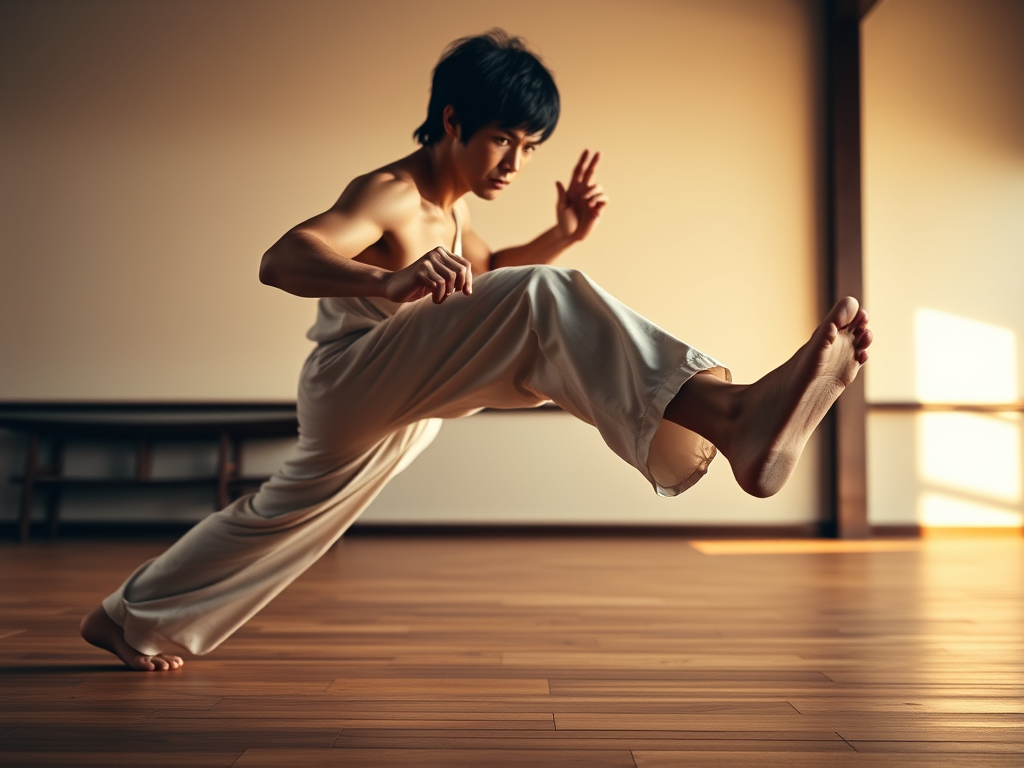
Listen to the podcast. Bruce Lee quotes read by AI. 

Background
Jeet Kune Do (JKD) is Bruce Lee’s personal expression of Martial Arts. It is a Chinese Martial Arts mixed with boxing and fencing. It rejects formality and emphasizes fluidly reacting to the opponent in the moment. According to Lee a person should individualize their JKD and, “Absorb what is useful, discard what is not, add what is uniquely your own.”
“What is Jeet Kune Do? Chinese martial art, definitely! It is a kind of Chinese martial art that does away with distinction of branches, an art that rejects formality, and an art that is liberated from tradition…It is ridiculous to pin down so-and-so’s type of Gang Fu as ‘Bruce Lee’s Jeet Kune Do.’ I call it Jeet Kune Do just because I want to emphasize the notion of deciding at the right moment in order to stop the enemy at the gate. Really there is no rigid form in Jeet Kune Do. All that there is is this understanding: If the enemy is cool, stay cooler than him. If the enemy moves, move faster than him; be concerned with the ends, not the means; master your own manipulation of force, don’t be restricted by your form.”
Bruce Lee, 1972, Words, 126-128
Curriculum
Here I have set down my interpretation of Lee’s JKD curriculum. This is only my interpretation and has been heavily influenced by the books Jeet Kune Do: A Comprehensive Guide to Bruce Lee’s Martial Way, John Little, Editor and Jeet Kune Do: The Arsenal of Self Expression, Teri Tom and the video Bruce Lee’s Fighting Method: Basic Training & Self-Defense Techniques. I have provided informative videos from the Dan Lok Youtube Channel featuring JKD instructor Octavio Quintero. This online curriculum allows you to become familiar with JKD but it is no subsitute for a qualified in person instructor.
Part 1: Stance
The JKD stance is heavily influenced by fencing. Normally the strong side foot is forward and the weak side foot is behind which is pointed at an angle with the heel slightly raised. The raised heel is like a trigger ready to propel the body forward. The knees are slightly bent and the hands are raised to protect the head. The strongside hand is in front of the weakside hand. The feet are a little wider than shoulder length.
Part 2: Footwork
The footwork should be economical and you should not move just to move. Don’t bounce needlessly but be controlled. Every movement is used to attack the opponent or to move away from an attack. Simplification and economy of motion are very important. One should be relaxed and ready to respond in an instant. Your footwork is used to advance, retreat, sidestep left, and sidestep right.
- Forward and Backward Shuffle (Step and Slide)
This involves taking a step forward and then gliding the back leg forward the same distance until you are back into the original JKD stance. The legs never cross one another. You can practice this in two movements and the shuffle is often used to size up your opponent at the beginning of a conflict. The Backward shuffle involves the back leg stepping back and the front gliding back until you are back in the JKD stance. Again the legs never cross each other.
- Sidestepping
This involves stepping to the left or right. To move right, the right foot goes first followed by the left. To move left, the left foot goes first followed by the right. The legs never cross one another. The body can slightly sway in the direction of the movement.
- Circling (Pivoting)
Circling is a variation of the side step. To circle right move the right foot first and to circle left use the left foot first. The second foot should pivot until you have settled back into the JKD stance.
- Quick Advance and Retreat (The Push Step)
The push step looks like the shuffle step but is faster. The back foot is propelling your body forward. It is not a hop and can be used to launch a punch or bridge the gap to an opponent. This is done in one fluid motion. The quick retreat is the opposite with the front foot pushing you to the rear.
Pendulum (Burst)
The pendulum step is used to quickly deliver a kick to an opponent. It involves one foot replacing the other foot in one fluid motion. The back leg swings forward and front leg moves out of the way to kick an opponent. This is less of a push and more of a pulling movement using your momentum. One can shuffle forward to attack or back to avoid an attack.
Part 3: Punches
Here are some general considerations on punching. The power of the punch is increased by the speed of it. The punch should be from the whole body and not just the arms. It includes the hips, shoulders, feet, and arms. The punch should come from the center of the body in a straight line in front of your nose. You should punch through your opponent or training bag.
- Straight Lead: One of Lee’s signature moves. He punches with a straight arm with the fist vertical instead of horizontal. This gives extra length to the punch and the straight arm gives additional power as it extends from the shoulder.
- Backfist: Often done using the lead hand. It is not the quickest or strongest but may be difficult to block. Perform with a whipping or snapping motion. This should be done in a non-telegraphed way. This may used with the drop shift to hit lower on the body.
- Corkscrew Hook: Your fist rotates counter clockwise to gain momentum as it strikes. The amount of rotation depends on how far you are away from your opponent. This may be used with the drop shift to hit lower on the body.
- Shovel Hook: Punch used liberally by Lee student Ted Wong. Keep the elbow close to the body and punch from lower to upper hitting into the opponent’s body. You can pivot your legs as you are punching. This may be used with the drop shift to hit lower on the body.
- Lead Hook: This is a hook punch that is done by keeping the arm as horizontal as possible.
- Rear Cross: This punch is from the rear hand and the arm is kept relatively straight from the body but the lower body pivots to curve the punch. It is slower than the front jab but may have more power. This may used with the drop shift to hit lower on the body.
- Straight Rear Punch: Also known as the Straight Rear Thrust. This punch is from the rear hand and the arm is kept relatively straight from the body. The punch is vertical. It is slower than the front jab but may have more power. This may used with the drop shift to hit lower on the body.
- Straight Blast: This is a quick series of straight punches rotating between left and right fists. The arms are kept straight.
- Uppercut horizontal Fist: A boxing inspired uppercut punch using a horizontal fist.
- Finger jab: A favorite of Lee used to temporarily incapacitate an oppoenent. Three of your fingers are kept together and aim for the eye. The longer finger should be bent to make it even with the shorter ones. It is the fastest attacking weapon. Can also be used as a finger flick to the eyes.
Part 4: Kicks
Here are some general considerations on kicking. Lee encouraged low line kicks because they were more practical in a street fight. These kicks were often delivered from the lead leg and were aimed at the groin, lower leg, and waist. These kicks could be delivered using the Pendulum motion to gain power.
- Groin Kick: Often delivered from a pendulum step with the lead leg. The top of the foot hits the groin.
- Front Kick: A lower kick that can use the ball of the foot to make contact.
- Hook Kick: This is a rising round house style kick but with more of a turn in the hip. This kick does not start off with a “chamber.”
- Side Kick: A standard side kick making contact with the bottom of the foot.
- Inverted Hook Kick: This is an angled kick that almost changes direction to hit the groin.
Part 5: Trapping
This is one of the hardest techniques to learn by watching a video. It needs to be practiced with another person along with guidance from a qualified instructor. Trapping is used in close range to misdirect or immobilize an opponent’s attack and to counter with your own attack. Over time, these techniques will be used less and less as you develop a sense of when an opponent will attack and are able to intercept that attack without trapping.
- Chi Sao “Sticky Hands”: This is a sensitivity drill that helps you get a feel for when your opponent may attack. Lee often demonstrated this using a blindfold to show that it is based on feeling. The drill involves two people with arms interlocked moving in a semi circle from side to side. One person needs to react to the other person moving and then an attack can be executed out of Chi Sao. This is very difficult to pick up by watching a video.
- Lap Sao “Grabbing Hand”: This is a widely used trapping technique that involves pulling your opponent’s arm towards you in order to counter with an attack. The attack can often include a backfist or punch.
- Pak Sao “Slapping block”: This is another widely used technique that involves slapping or deflecting an opponents arm in order to counter attack.
- Huen Sao: This technique is not used as often and involves circling your wrist around an opponent’s arm in order to attack from a different angle. The counter attack can be a slap or backfist.
- Straight Blocks: The hope is over time your trapping techniques will evolve into a straight block where you are blocking your opponent’s attack with an attack of your own. This takes a considerable amount of practice to develop your sense of timing. In a way the other trapping techniques are a bridge to the straight block. An example is that your block your opponent’s punch with a punch of your own which also deflects their arm.
Part 6: Philosophy
Any discussion of Bruce Lee’s fighting philosophy would take years of study and need to be written down in lengthy books to do it justice. One such book to check out is the Tao of Jeet Kune Do written by Bruce Lee. However, I will outline some of Bruce Lee’s fighting philosophy.
- Offense: Attacks can be summarized by the five ways of attack.
- Simple Direct Attack (SDA) – A simple attack to hit or kick your opponent using a straight line. This is difficult to accomplish because there is no misdirection and requires speed and timing.
- Attack by Combination (ABC) – This involves attacking an opponent in a series of ways which can include multiple kids, punches, elbows, knees, etc. The hope is that the opponent will not be able to block all the attacks or get overwhelmed by the combination.
- Progressive Indirect Attack (PIA) – This is using a fake attack (feint) to mislead the opponent and following up with your intended attack.
- Hand Immobilizing Attack (HIA) – This is trapping your opponent’s hand or leg so you can follow up with an attack.
- Attack By Drawing (ABD) – This involves presenting a fake weakness to your opponent to mislead them into attacking. Then you follow up with your own attack.
- Defense: Jeet Kune Do stands for The Way of the Intercepting fist. A person’s best defense is your own attack. This is sometimes called a “stop hit” or “stop kick.” Short of this you can deflect an attack with one hand and attack with the other. Examples of defenses include parrying (deflecting), blocking, evading, and redirecting.
- Stance: The stance puts your strong side forward. If you are right handed your right leg and right arm are closest to the opponent. This is called “Southpaw” in boxing. This puts your strongest side closest to the opponent for a quick attack.
- Footwork: Footwork involves the back foot being slightly raised, ready to propel the body forward for an attack. This is taken from fencing. In general a person should move quickly but be able to maintain balance.
- Punches: Punches should be thrown quickly but the body should not be tense. Punches should be non-telegraphed and take the opponent by surprise. The front hand often throws a straight punch with a vertical fist.
- Kicks: Kicks are often aimed at the lower body and can include side kicks, front kicks, and strikes to the groin. They often begin the attack and can be done to simply distract the opponent from another attack.
- Economy of Motion: All attacks and defenses should be done as simple as possible. They should be the most efficient and direct as possible.
- Range: It can be helpful to think about a fight using ranges. The long range involves kicking attacks, medium range includes kicking and punching attacks, and short/close range includes short kicking, punching, trapping, and grappling. It helps to notice which range you excel at and which range your need to practice.
- Broken Rhythm: Timing was very important to Lee. He wanted to be able to anticipate when an opponent might strike and notice patterns to the opponent’s attacks. Broken rhythm involves starting with a pattern of attack against an opponent and then changing the pattern to confuse the opponent. For example, you might do a jab and punch combination several times. On the fourth time you throw a jab and then an uppercut to see if you can make contact with the opponent.
- Flexibility: Lee is well known for his quote to “Be like water.” Water is fluid and moves around obstacles. In the same way his fighting philosophy emphasizes adapting to the opponent. Don’t box a boxer or wrestle a grappler. Consider the size of yourself and your opponent and make sure to choose the best type of attack that works in your particular situation.
Health Information
This is for general informational purposes only. You should always consult a medical professional before engaging in any exercise program. Bruce Lee would have encouraged you to explore these training methods to see what works for you. Do not be afraid to modify this plan and adjust based on your own personal experience. “Adapt what is useful, reject what is useless, and add what is specifically your own.” Bruce Lee
Resources:
Dan Lok featuring Octavio Quintero Youtube Channel.
Words of the Dragon: Interviews, 1958-1973, John Little, Editor, Tuttle Publishing, 1997, 2017. Volume 1 of the Bruce Lee Library, commissioned by the Bruce Lee Estate. Interview transcripts of Bruce Lee on a variety of topics including philosophy, martial arts, and his personal life. Put together by John Little, Bruce Lee historian.
Jeet Kune Do: A Comprehensive Guide to Bruce Lee’s Martial Way, John Little, Editor, Tuttle Publishing, 1997, 2020. Volume 3 of the Bruce Lee Library. Excellent and detailed description of Bruce Lee’s martial art before he passed. Put together by John Little, Bruce Lee historian.
Bruce Lee’s Fighting Method: Basic Training & Self-Defense Techniques, Ted Wong and Richard Bustillo. 1992. Instructional video by two students of Bruce Lee which covers the JKD stance, footwork, power punching, and self defense. 52 M (IMDB).
AI Narration provided by elevenlabs.io. Bruce Lee quotes read by AI voice over.