
Background
Jeet Kune Do (JKD) is Bruce Lee’s personal expression of Martial Arts. It is a Chinese Martial Arts mixed with boxing and fencing. It rejects formality and emphasizes fluidly reacting to the opponent in the moment. According to Lee a person should individualize their JKD and, “Absorb what is useful, discard what is not, add what is uniquely your own.”
“What is Jeet Kune Do? Chinese martial art, definitely! It is a kind of Chinese martial art that does away with distinction of branches, an art that rejects formality, and an art that is liberated from tradition…It is ridiculous to pin down so-and-so’s type of Gang Fu as ‘Bruce Lee’s Jeet Kune Do.’ I call it Jeet Kune Do just because I want to emphasize the notion of deciding at the right moment in order to stop the enemy at the gate. Really there is no rigid form in Jeet Kune Do. All that there is is this understanding: If the enemy is cool, stay cooler than him. If the enemy moves, move faster than him; be concerned with the ends, not the means; master your own manipulation of force, don’t be restricted by your form.” (Bruce Lee, 1972, Words, 126-128).
Curriculum
Here I have set down my interpretation of Lee’s JKD curriculum. This is only my interpretation and has been heavily influenced by the books Jeet Kune Do: A Comprehensive Guide to Bruce Lee’s Martial Way, John Little, Editor and Jeet Kune Do: The Arsenal of Self Expression, Teri Tom and the video Bruce Lee’s Fighting Method: Basic Training & Self-Defense Techniques. I have provided informative videos from the Dan Lok Youtube Channel featuring JKD instructor Octavio Quintero. This online curriculum allows you to become familiar with JKD but it is no substitute for a qualified in person instructor.
General Thoughts on Trapping
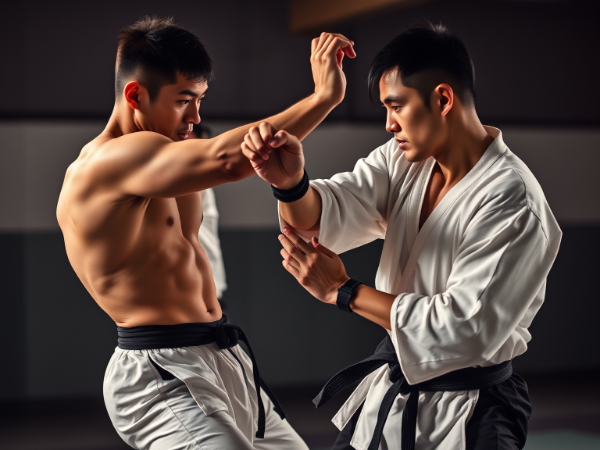
This is one of the hardest techniques to learn by watching a video. It needs to be practiced with another person along with guidance from a qualified instructor. Trapping is used in close range to misdirect or immobilize an opponent’s attack and to counter with your own attack. Over time, these techniques will be used less and less as you develop a sense of when an opponent will attack and are able to intercept that attack without trapping.
- Chi Sao “Sticky Hands”: This is a sensitivity drill that helps you get a feel for when your opponent may attack. Lee often demonstrated this using a blindfold to show that it is based on feeling. The drill involves two people with arms interlocked moving in a semi circle from side to side. One person needs to react to the other person moving and then an attack can be executed out of Chi Sao. This is very difficult to pick up by watching a video.
- Lap Sao “Grabbing Hand”: This is a widely used trapping technique that involves pulling your opponent’s arm towards you in order to counter with an attack. The attack can often include a backfist or punch.
- Pak Sao “Slapping block”: This is another widely used technique that involves slapping or deflecting an opponents arm in order to counter attack.
- Huen Sao: This technique is not used as often and involves circling your wrist around an opponent’s arm in order to attack from a different angle. The counter attack can be a slap or backfist.
- Straight Blocks: The hope is over time your trapping techniques will evolve into a straight block where you are blocking your opponent’s attack with an attack of your own. This takes a considerable amount of practice to develop your sense of timing. In a way the other trapping techniques are a bridge to the straight block. An example is that your block your opponent’s punch with a punch of your own which also deflects their arm.
Health Information
This is for general informational purposes only. You should always consult a medical professional before engaging in any exercise program. Bruce Lee would have encouraged you to explore these training methods to see what works for you. Do not be afraid to modify this plan and adjust based on your own personal experience. “Adapt what is useful, reject what is useless, and add what is specifically your own.” Bruce Lee
Resources:
Dan Lok featuring Octavio Quintero Youtube Channel.
Words of the Dragon: Interviews, 1958-1973, John Little, Editor, Tuttle Publishing, 1997, 2017. Volume 1 of the Bruce Lee Library, commissioned by the Bruce Lee Estate. Interview transcripts of Bruce Lee on a variety of topics including philosophy, martial arts, and his personal life. Put together by John Little, Bruce Lee historian.
Jeet Kune Do: A Comprehensive Guide to Bruce Lee’s Martial Way, John Little, Editor, Tuttle Publishing, 1997, 2020. Volume 3 of the Bruce Lee Library. Excellent and detailed description of Bruce Lee’s martial art before he passed. Put together by John Little, Bruce Lee historian.
Jeet Kune Do: The Arsenal of Self Expression, Teri Tom, Author, Tuttle Publishing, 2009, 2016. In-depth guide to Jeet Kune Do including kicks, punches, and technique.
Bruce Lee’s Fighting Method: Basic Training & Self-Defense Techniques, Ted Wong and Richard Bustillo. 1992. Instructional video by two students of Bruce Lee which covers the JKD stance, footwork, power punching, and self defense. 52 M (IMDB).
AI Narration provided by elevenlabs.io. Bruce Lee quotes read by AI.